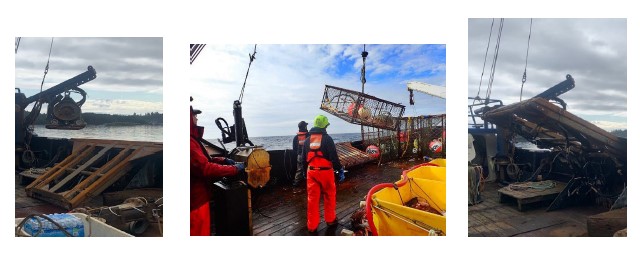
In light of the recent fatality aboard a commercial fishing vessel and in advance of an approaching period of increased pot fishing activity, the Coast Guard offers the following to operators and crews engaged in pot fisheries.
Identification, Orientation and Training
Realizing the varying levels of crew experience aboard all commercial fishing vessels, the Coast Guard encourages vessel captains to review and remind crewmembers of on-deck hazards. Orienting crew to vessel specific “pinch-points,” blind spots, “no-go” areas and crushing hazards as a “best practice” is critical to preventing casualties, raising awareness and overall deck safety.
Audible/Visual Communications and Accountability
Consider a system for on-deck verbal and/or visual communication, personnel accountability prior to and during the use of launching, rotating and lifting equipment. Understanding that operating in an extreme dynamic environment may increase the challenge of identifying crewmember location, the totality of circumstances may support the need to establish an audible confirmation method.
Vessel Configuration
While there are similarities between vessels and their equipment, it is safe to say that no two vessels are exactly the same when it comes to equipment, visibility and configuration. (For example, depending on deck load, a house aft configured vessel may be considered to have an additional set of eyes and favorable vantage point over operations on deck, where that may not be the case for a house forward vessel whose operations are typically behind them.)
Conclusion
While there is no one answer or solution to eliminating all the inherent hazards aboard a commercial fishing vessel, the Coast Guard encourages the industry to discuss these types of incidents with industry peers, safety and training organizations, vessel ownerships and with Coast Guard fishing vessel safety and marine inspections personnel. Please remain vigilant and safe when operating.